Ninety-some minutes under foil is a long stretch for a side dish, and the timing is the part that catches people. Cheesy scalloped potatoes ask you to wait while the potatoes soften in their own steam, and the reward is slices that give under a fork instead of fighting back.
The trouble shows up early: if the sauce goes over the layers too thin, the whole thing bakes into a puddle with cheese floating on top. Get it thick enough to coat a whisk and the bake holds together. You can assemble it a day ahead and slide it into the oven when the roast comes out, or bake it through and reheat.
Leftovers tighten in the cold, so loosen them with a little milk. Worth the wait, especially next to something carved.
Why a Roux Builds a Better Cheese Sauce
Melted cheese stirred straight into warm milk looks fine for a minute. Then it tightens into strings and leaves a slick of fat on the surface.
The flour and butter cooked together first change that. The starch grains grab onto the butterfat, then swell as the milk goes in, and the sauce thickens into something with body.
That body is what keeps the cheese suspended instead of pooling at the bottom of the dish. Get the base smooth before any cheese goes near it. If there’s a lump now, there’s a lump later, and no amount of stirring will fix it once the cheese is in.
A sauce that’s already silky takes the cheese without complaint, and the finished dish cuts into clean squares rather than sliding apart in a watery puddle. You can feel the difference on the whisk: thin milk turning heavy and coating the wires.
Even Slices, Tender Bites
Cut one potato at a quarter inch and the next at an eighth and you’ve set up a lottery. The thin ones cook through in half the time, collapsing into the sauce while the thick ones hold their shape and stay chalky in the middle.
A mandoline makes short work of it, but a sharp knife and a steady hand do the job. What matters is that every slice hits the sauce at the same thickness, so they all reach tenderness on the same schedule. The onion rings tucked between the layers do more than flavor.
They release water as they cook, and that moisture helps the potatoes steam from within the covered dish. Without them, the sauce would be the only liquid, and the potatoes would soak it up unevenly. With them, every forkful gets a little sweetness and a little give.
Foil First, Broil Last
Potatoes need steady, moist heat to soften all the way through. Left uncovered in a hot oven, the top slices dry out and curl at the edges before the middle ones are anywhere near done.
Foil traps the steam rising off the sauce, and that steam does the heavy lifting, cooking the slices from every side at once. Under the foil, the sauce bubbles gently against the potatoes, thickening as it goes. The whole thing turns into a tight, creamy mass.
But foil also traps that moisture on the surface, so the top stays pale and soft. That’s where the broiler comes in. A few minutes under high heat drives off the last of the surface water and browns the cheese, giving you a crisp lid over the tender layers.
The contrast is what makes the dish worth the wait: a crackly top, a spoonable middle.
Mild Cheddar and Whole Milk
Whole milk carries enough fat to coat the tongue and keep the sauce from breaking when it hits the heat. Skim or low-fat milk may look like it’s working on the stove, but it thins out in the oven and leaves the potatoes sitting in a watery liquid. Mild cheddar melts into a smooth, glossy sauce without shouting over the potatoes.
A sharp or aged cheddar can turn grainy under heat and its tang would dominate every bite. Here, the cheese is a supporting player, adding richness and a gentle pull. Salt and pepper go in at the end, after the sauce has had its long bake.
Seasoning early gets lost in the cooking, and you can’t taste the true balance until the dish comes out. Taste a spoonful of the hot sauce before it goes over the potatoes, then adjust.
What you want is a sauce that tastes faintly of dairy and potato, nothing more.
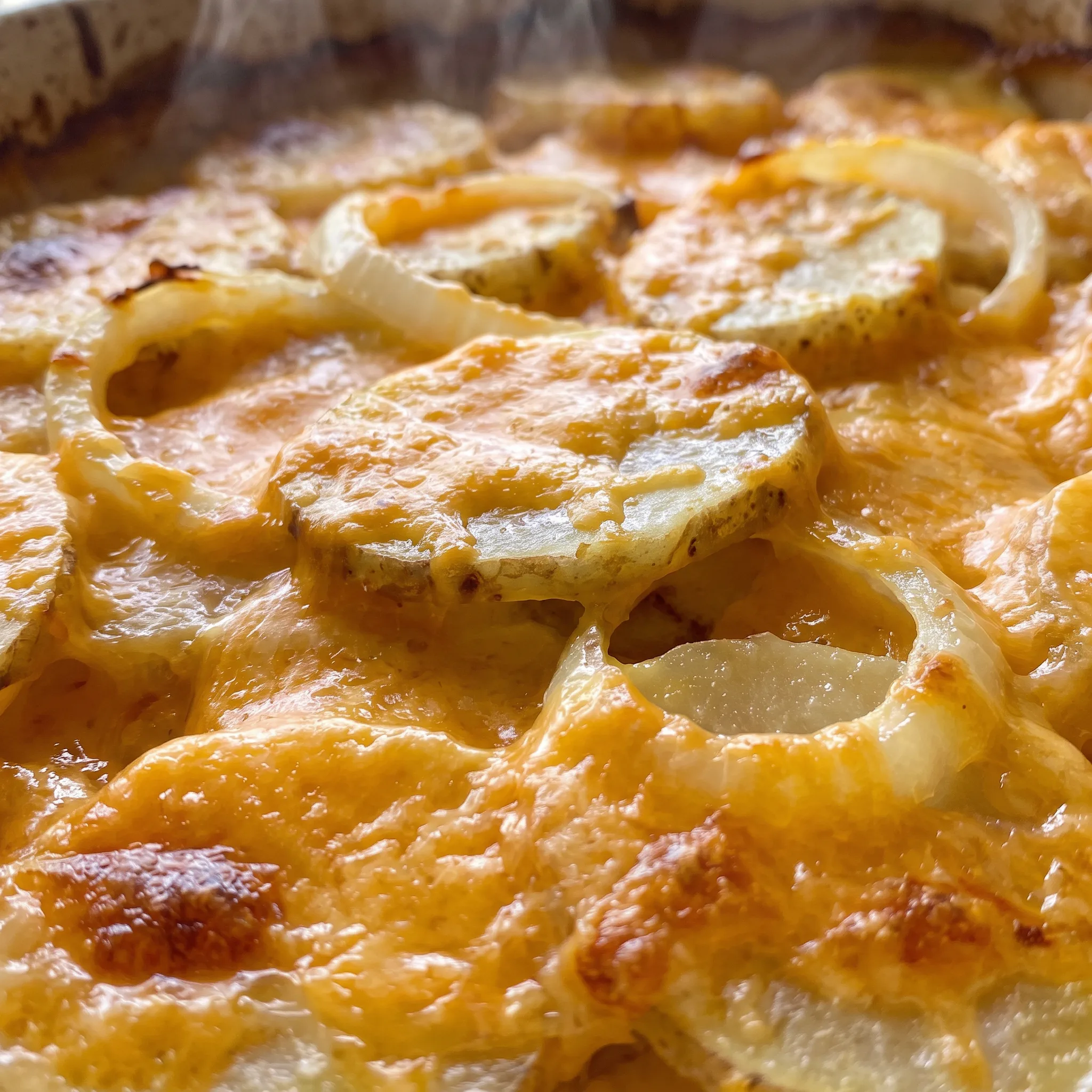
What to Buy and How to Prep It
Russet potatoes: Their high starch breaks down in the bake and thickens the sauce, so waxy red or gold potatoes stay firm and never cream up.
Yellow onion: Sliced into full rings, it goes in raw between the potato layers rather than softened first, releasing water that steams the slices.
Whole milk: Room temperature keeps the sauce from seizing when it hits the hot roux, so pull it out before you start melting butter.
Mild cheddar: Shred it yourself off the block, since the pre-shredded bag is dusted with starch that keeps it from melting smooth.
Kosher salt: The ½ teaspoon goes into the roux, and the rest waits for the end, so keep the flaky kind on hand for finishing.
Unsalted butter: It lets you taste the sauce before the cheese goes in, since salted butter stacks its own sodium on top of the cheddar.
The flour in the roux must first absorb the melted butter and then the milk, swelling and gelatinizing to form a stable starch network that holds the sauce together. If cheese is stirred in before that network is fully developed, or if the sauce is kept at a hard boil afterward, the cheese’s proteins tighten and its fat separates, leaving a greasy, grainy texture. This recipe uses a cooked roux base and adds the cheese only after the milk mixture has thickened, relying on the starch to keep the cheese emulsified rather than melting cheese directly into hot milk.
Reading the Sauce, the Slices, and the Bake
When the sauce is thick enough to hold cheese
After you add the milk, the sauce needs to thicken before the cheese goes in. Look for it to coat the whisk and leave a trail when you drag it through. If it’s still thin like milk, keep cooking.
If you add cheese now, the sauce will stay loose and the potatoes will sit in liquid. It should feel heavy on the whisk, not watery. This usually takes a few minutes, but judge by feel, not the clock.
Judging doneness through the foil
The potatoes bake covered for 85 to 90 minutes. Near the end, carefully lift a corner of the foil and pierce the center with a knife. It should slide in with almost no resistance, like going into soft butter.
If there’s any firmness, re-cover and give it another 10 minutes. The slices at the edge may finish first, so test the middle. Underdone potatoes stay crunchy and ruin the texture.
The broiler’s short window
Broiling goes fast. Stay at the oven and watch.
The top should turn golden brown in spots, not dark brown. That takes 2 to 4 minutes, depending on your broiler. The moment you see deep color, pull it.
Burnt cheese tastes bitter and can’t be fixed. If you smell scorching, it’s already too late.
Better to under-brown than to burn.
Cheesy Scalloped Potatoes with Cheddar and Onion
Ingredients
- 4 russet potatoes about 2 lb / 907 g, peeled and sliced into ¼-inch slices
- 1 yellow onion sliced into rings
- 3 tbsp unsalted butter 42 g
- 3 tbsp all-purpose flour 23 g
- ½ tsp kosher salt
- 2 cups whole milk room temperature
- 1½ cups mild cheddar cheese shredded
- salt and pepper to taste
Instructions
- Preheat oven to 400°F (205°C). Lightly spray an 8×8-inch casserole dish with nonstick cooking spray.
- Arrange the potatoes and onions in the prepared baking dish, staggering potato and then onion.
- In a medium-size saucepan, melt butter over medium heat. Mix in the flour and salt, and stir constantly with a whisk for one minute. Stir in milk. Cook until mixture has thickened.
- Stir in cheese all at once, and continue stirring until melted and smooth, about 30-60 seconds.
- Pour the cheese sauce over the potatoes, and cover the dish with aluminum foil.
- Bake for 85-90 minutes, or until the potatoes are tender.
- For a crisp topping, change the oven setting to broil after the potatoes are baked. Broil until golden brown.
- Season with salt and pepper to taste and serve.
Swaps That Hold the Sauce, Swaps That Break It
Whole milk: 2% milk, or a mix of 1 cup whole milk and 1 cup half-and-half. Whole milk has enough fat to keep the sauce thick and creamy through the long bake. 2% will work but the sauce turns out thinner, and the potatoes may release liquid and leave a pool in the dish.
Half-and-half makes it richer, closer to a cream sauce, but can feel heavy. If you use 2%, expect a looser set and season a touch more at the end. Don’t use skim; the sauce will look fine on the stove then separate in the oven.
Mild cheddar cheese: Colby Jack, Monterey Jack, or a young gouda. These melt smoothly and stay mild, so the sauce keeps its creamy texture.
A sharp or aged cheddar will turn grainy and greasy under heat, and its tang will overpower the potatoes. If you only have sharp cheddar, combine it half-and-half with a mild melting cheese to limit the damage. Shred any of these yourself; pre-shredded bags are dusted with starch that keeps the sauce from coming together.
Russet potatoes: Yukon Gold potatoes. Yukon Golds are waxy, so they hold their shape instead of breaking down. The sauce will be thinner because they don’t release starch the way russets do, and the slices will have a firmer bite.
They still taste good, but the dish won’t have that cohesive, creamy body. Red potatoes are even waxier and will stay distinct, almost like sliced boiled potatoes in sauce. Stick with russets if you want the classic result.
Unsalted butter: Salted butter. Salted butter adds sodium to the roux, and since the cheese brings its own salt, the finished dish can taste overly salty.
If you use salted butter, cut the ½ teaspoon kosher salt in the roux to a pinch, then taste the sauce before adding cheese. Adjust the final seasoning after baking. The butter’s role is to carry the flour and add richness, so the swap works, but you’ll need to season with a lighter hand.
All-purpose flour: Gluten-free all-purpose blend (cup-for-cup style). A cup-for-cup gluten-free blend will thicken the sauce similarly, but the texture can be slightly grainy. The sauce may not have the same glossy smoothness.
Use the same 3 tablespoons. Let the sauce cook a minute longer after adding the milk to fully hydrate the starches.
The finished dish will be a bit less cohesive but still creamy.
Tips
- Taste the finished cheese sauce for salt before pouring it over the potatoes. Cheddar’s sodium swings by brand, and the potatoes pull seasoning from the sauce as they bake, so a sauce that tastes right on the spoon can end up undersalted in the finished dish. If it tastes flat now, add a pinch more; if it tastes just salty enough, leave it.
Storage, Reheating, and the Serving Window
Eat this within 20 to 30 minutes of pulling it from the broiler. That’s when the top is crackly and the sauce is loose enough to spoon.
Past that, the crust softens as steam moves up from the potatoes, and the sauce tightens against the cooling slices. The dish is still good warm, but the contrast is gone.
Cool leftovers within an hour, then refrigerate covered. The sauce thickens further in the cold and the potatoes firm up, so a reheated portion needs a splash of milk before it goes back in a 350°F oven, covered, until it loosens. A dry bake without that liquid leaves the slices tight and pasty.
Keep refrigerated up to 3 days. Freeze only the baked dish, well wrapped, up to 2 months.
The sauce separates on thaw and the potatoes turn grainy, so it’s a backup, not a match for fresh. Reheat frozen portions covered with milk until hot through.
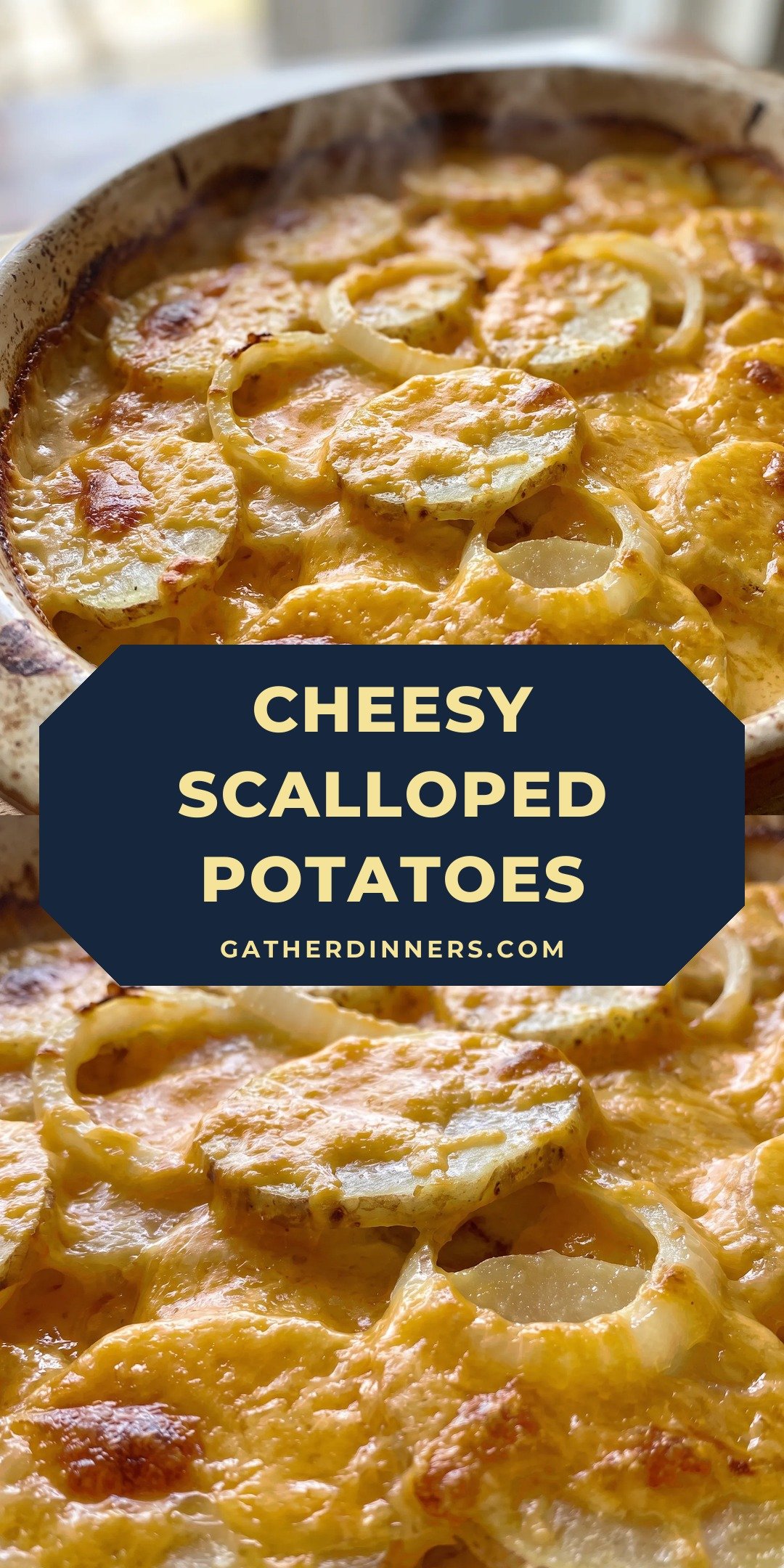
Frequently Asked Questions
Can I make cheesy scalloped potatoes ahead of time?
You can assemble the whole dish a day ahead and refrigerate it covered, then bake it when you’re ready. The potatoes will darken a bit in the cold, but the flavor holds up fine.
If you want to bake it ahead, cool it within an hour, refrigerate, and reheat covered at 350°F with a splash of milk to loosen the sauce. Leftovers keep up to 3 days in the fridge, and you can freeze the baked dish up to 2 months, though the sauce separates on thaw.
Why did my scalloped potatoes turn out watery?
The usual culprit is the sauce going in too thin, before the roux has thickened enough to hold the cheese. If it looked like milk on the whisk rather than coating it heavily, the potatoes end up sitting in liquid. Check your milk next: skim or low-fat thins out in the oven, while whole milk keeps the sauce creamy.
Another cause is skipping the flour or butter in the roux, which leaves nothing to trap the cheese and potato starches.
What’s the difference between scalloped potatoes and au gratin potatoes?
Scalloped potatoes are built on a white sauce made from a butter-flour roux and milk, with cheese often stirred in but not required. Au gratin potatoes typically have cheese as the defining element, often layered with cream or a lighter sauce and topped with breadcrumbs.
The dish here leans scalloped in method, using a roux base and mild cheddar for richness. Both bake covered until tender, but the sauce structure sets them apart.