An acorn donut hole isn’t baked, and it isn’t a cookie sandwich pressed into a shape. It’s a store-bought donut hole dipped partway, rolled in sprinkles, and given a pretzel stem, which means the whole thing lives or dies on a dip line and a window of tackiness that closes faster than you’d think. The failure mode is specific: coat too far up and the acorn disappears into a chocolate blob; wait too long and the stem won’t bite.
Get the half-dip right and a bag of donut holes turns into a bowl of acorns in about the time it takes to clear a counter. Where it gets fiddly is the set, since the coating has to be firm enough to hold and soft enough to grip at nearly the same moment.
The recipe’s hard step is timing the pretzel insertion relative to the chocolate’s setting. If you wait until the coating is fully firm, the pretzel simply rests on the surface and slides out; if you insert while the coating is still warm and tacky, the chocolate can flow into the rough surface of the pretzel and lock it in place as it cools. This recipe uses the warm-coating method because the coating is still fluid enough to grip, but not so hot that it soaks the donut hole.
The No-Bake Assembly and Its Setting Coating
Warming the spread just until it turns fluid enough to coat is the difference between a tidy finished piece and one that drinks up chocolate and sags. Heat pushes it past that point quickly, so the bowl should feel barely warm against your wrist, not hot. At that consistency it clings in a thin layer instead of soaking in.
Once each donut hole is coated and resting on wax paper, the coating firms at room temperature into a shell that holds its shape. That shell is what makes the finished piece sturdy enough to pick up without smearing, and it’s what keeps the pretzel stem standing straight. Purchased donut holes are the right starting point because their crumb is already set and tender.
Baking them from scratch would mean a fresh, fragile interior that collapses under the weight of the coating and the stem. This method works because the coating sets, not because the donut is baked.
Inserting the Stem Before the Coating Sets
The pretzel stick has to go in while the chocolate is still tacky at the top. Wait until the coating has firmed all the way and the pretzel will slide out with the slightest tilt, leaving a hole where the stem should be.
There’s a window of a minute or two after dipping when the surface is set enough to hold but still soft enough to grip. Push the snapped half in then. A broken pretzel gives you a rough, jagged end that bites into the coating far better than a smooth manufactured tip would.
That texture is what locks the stem in place. Snapping the sticks in half matters for scale as much as stability: a full pretzel dwarfs the donut hole and throws off the whole silhouette, while a half sits in proportion.
The finished piece should feel solid when you lift it by the stem, not wobbly.
Sprinkles as a Dry, Grippy Coating
Rolling the dipped donut hole in sprinkles right away does more than make it pretty. The coating is sticky at that stage, and sprinkles pressed into it create a dry surface that won’t smear against your fingers or the next piece on the tray.
They also add a crisp bite that cuts through the soft donut and smooth chocolate. Without that crunch, every mouthful would be one texture, and the whole thing would feel heavier than it needs to. Mixing two varieties of autumn sprinkles gives you better coverage, since one shape or size fills the gaps another leaves, and the color variation reads as depth rather than a flat dusting.
The coating underneath shouldn’t show through once you’re done rolling. A finished piece should look evenly speckled, with no bald patches where the chocolate gleams through. That even coat is also what keeps the pieces from sticking together as they sit.
Reading as an Acorn, Not a Decorated Donut Hole
The illusion depends on the half-dip. Leaving the top of the donut hole bare gives you a pale cap that echoes the real acorn’s lid, and the brown coating below suggests the shell. If the whole thing were dunked, you’d lose that two-tone break and it would just look like a chocolate-covered donut hole.
Autumn sprinkles over the brown coating reinforce the shell color, so the eye reads acorn before it reads snack. Proportion ties it together: the pretzel stem has to be thin and short, or it looks like a handle. A stubby stem sits close to the cap and finishes the shape cleanly.
When the pieces are lined up on wax paper, the ones that read best are the ones where the bare cap is roughly a third of the height. That’s the visual cue that sells it, and it’s the one worth checking before you set the tray down.
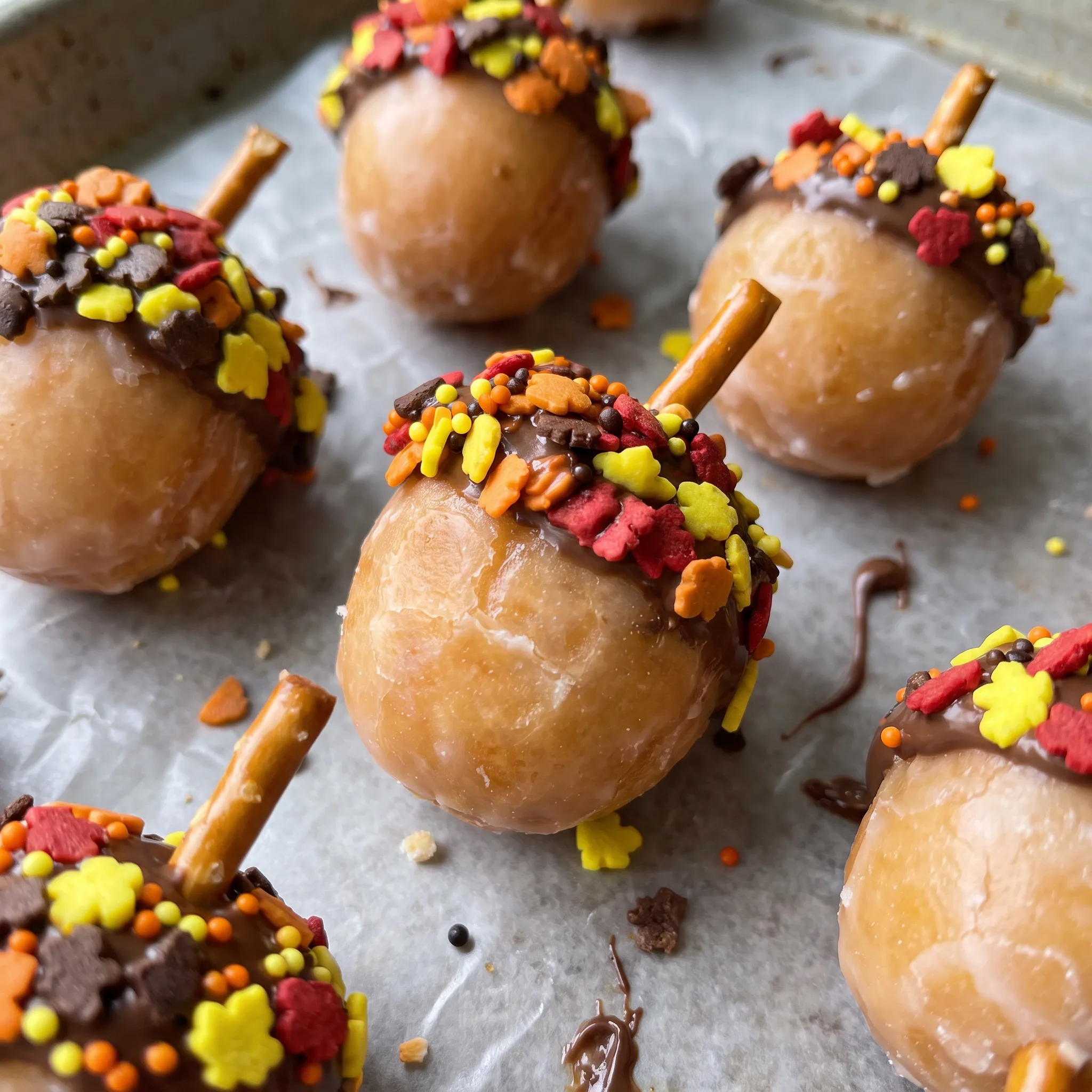
The Four Ingredients That Decide Whether These Read as Acorns
Purchased donut holes: Buy plain glazed or unglazed cake donut holes with a set crumb, since a soft, fresh interior sags under the coating.
Chocolate hazelnut spread or chocolate icing: A spread that stays glossy and thin when barely warmed coats evenly; a stiff icing drags and tears the donut hole instead.
Autumn-themed sprinkles: Choose a mix of shapes and sizes, since uniform sprinkles leave bald patches where the brown coating shows through.
Thin pretzel sticks: Pick the thinnest sticks in the bag, because a thick one reads as a handle rather than a stem.
Judging the Dip, the Set, and the Silhouette as You Work
Reading the spread when it’s fluid enough to coat
Fifteen to twenty seconds in the microwave is a guide, not a rule. What you’re watching for is a spread that ribbons off a spoon and falls back into the bowl in a slow, even stream. If it’s still mounded and thick, it’ll tear the donut hole instead of coating it.
If it’s thin and runny, it’ll slide off and leave bald patches. Pull it early and stir; residual heat often finishes the job.
Telling when the coating has set enough to handle
The shell firms as it cools, and the tell is touch, not time. Press a coated piece lightly with a fingertip: if the surface doesn’t dent or cling, it’s ready. If your finger leaves a print, wait.
Moving them too soon smears the coating into the sprinkles and leaves a wet ring on the wax paper. On a cool counter this takes longer than you’d expect; a warm kitchen stretches it further.
Judging the stem’s grip before the coating hardens
Push the pretzel in while the top is still tacky. You’ll feel resistance give way to a soft hold.
If the coating has already firmed, the pretzel goes in with a crack and wobbles. That’s the miss to watch for. A jagged snapped end grips better than a clean cut, so break the sticks rather than slicing them.
Lift a finished piece by the stem to check: it should feel solid, not loose.
How much bare cap shows above the coating
Aim to leave roughly the top third of the donut hole uncoated. That pale band is what reads as the acorn’s lid.
Dip too deep and the two-tone break disappears; the piece just looks like a chocolate-covered donut hole. Dip too shallow and the coating looks like a smudge. Check one before you commit the rest, since the angle you hold it at sets the line.
When the coating is too hot to hold the sprinkles
Sprinkles pressed onto coating that’s still warm sink in and disappear; on coating that’s fully set, they bounce off. The window is narrow. Roll each piece immediately after dipping, while the surface is sticky but not wet.
If the sprinkles slide or the coating smears, the spread was too warm. Let it sit a moment and stir before the next one. Even coverage matters more than speed.

Acorn Donut Holes with Chocolate Hazelnut Spread
Ingredients
- purchased donut holes
- chocolate hazelnut spread or chocolate icing
- autumn-themed sprinkles
- thin pretzel sticks snapped into halves
Instructions
- Transfer the autumn-themed sprinkles into a small bowl (you can mix two varieties). Cover your workspace with wax paper to prepare for assembly.
- In a deep, small microwave-safe bowl, warm the chocolate hazelnut spread or chocolate icing for approximately 15–20 seconds, until it is just melted. Submerge each donut hole halfway into the melted spread/icing, then roll it in the sprinkles. Push one pretzel half into the top of every ‘acorn’ and allow them to set on the wax paper.
Storage and Serving: When to Eat Acorn Donut Holes
Serve these the day you assemble them. A purchased donut hole is tender and moist when fresh, and that moisture is what stales first. Inside a sealed container at room temperature, the coating holds its snap and the sprinkles stay put for a few hours, but the crumb tightens hour by hour.
Past the first day, the pretzel stem softens against the coating and pulls loose. The fridge is worse for texture: the chocolate shell sweats, then dulls, and the sprinkles go tacky against the container.
Cold also firms the donut into something dry. If you must refrigerate, let the pieces sit out until the condensation dries before serving.
Freezing doesn’t work here: thawing draws moisture to the surface and the coating weeps, so the sprinkle coat slides off. Keep the pretzel stems in place only for the pieces you’ll serve soon. Add the stems at the very end, right before the tray goes out, since they’re the first thing to go slack.
Set the acorns out within an hour of eating them.
Which of These Four Ingredients Can Take a Swap and Which Can’t
Purchased donut holes: Glazed, unglazed, cake-style, or yeast-raised all work, as long as the crumb is set and not warm from the fryer. A fresh, soft donut hole sags once the coating goes on and the pretzel leans. Day-old or firm-crumbed ones hold the half-dip line and the stem without giving.
If you can’t find plain cake, a glazed yeast hole is fine; just blot the glaze with a paper towel so the chocolate has something dry to grab.
Chocolate hazelnut spread: Chocolate icing, or a mix of the two. Spread warms thin and glossy in 15 to 20 seconds and coats in a sheer layer that sets to a shell.
Icing is thicker; it drags across the donut hole and can tear the surface if you rush it. If you use icing, warm it in 5-second bursts and stir until it ribbons off the spoon.
Straight chocolate icing sets harder than spread and gives a snappier bite, while spread stays a touch softer and tastes of hazelnut. Neither is wrong, but the icing version needs a lighter hand.
Autumn-themed sprinkles: Any small, irregular sprinkle mix, or finely chopped nuts if you want a different crunch. The sprinkles are the dry, grippy layer that keeps the pieces from smearing and sticking together. Uniform round nonpareils leave bald patches where the brown coating shows.
Chopped nuts press in fine and add a coarser crunch, but they’re heavier, so roll gently or they’ll pull the coating down the sides. If you swap to a single shape, expect more of the chocolate to peek through.
Thin pretzel sticks: The thinnest sticks you can find. Skip thick pretzel rods or standard twists.
A thin stick reads as a stem and snaps into a jagged end that grips the tacky coating. Thick rods look like handles and won’t stay put in a donut hole this size. If all you have are thick sticks, snap them shorter and push them in at a slight angle, but know the silhouette won’t be as clean.
There’s no good gluten-free stand-in that keeps the same snap and grip, so leave these as-is unless you’re willing to lose the stem.
Tips
- Before dipping the first donut hole, drop one in and watch how far it sinks. If it floats with the coating line above the halfway mark, the spread is thin enough to slide off and leave bald patches; if it sinks to the bottom of the bowl, the spread is thick and will drag the crumb. The right spread lets the hole settle slowly to about its midpoint and stay there.
- Dip one test hole and set it on wax paper for two minutes. If a ring of chocolate bleeds outward onto the paper, the spread is too warm and will soak the crumb before it sets. If the coating holds a sharp edge with no halo, the temperature is right for the rest of the batch.

Frequently Asked Questions
Can I make these acorn donut holes ahead of time?
Assemble them the day you plan to serve them, and add the pretzel stems at the very end, right before the tray goes out. That order matters because the stem is the first part to go slack against a coating that’s had hours to sit.
Held at room temperature in a sealed container, the coating keeps its snap and the sprinkles stay put for a few hours, though the crumb tightens as the day goes on. Past the first day the pretzel softens and pulls loose, so there’s no real head start to be had here.
Why did my pretzel sticks fall out of the acorn donut holes?
Most likely you pushed them in after the coating had firmed, which is the usual culprit. The pretzel needs a tacky surface to bite into; once the chocolate has set, the stick goes in with a small crack and never really grips. If timing wasn’t the issue, check the stick itself: a thick rod sits like a handle and won’t hold in a donut hole this size, while a snapped half gives you a jagged end that digs in.
Lift a finished piece by the stem as your test, and if it feels loose rather than solid, that’s the one to eat first.
How are these different from traditional acorn treats made with Nutter Butters?
Nutter Butter versions rely on the cookie’s ridged edge to suggest the acorn cap, so the shape is baked in before you touch it. Here the cap is created by the half-dip, leaving the top third of the donut hole bare as a pale band above the brown coating.
That means the look depends on your hand and the angle you dip at, not on what you bought. The payoff is a softer, cakier bite under the chocolate shell instead of a crumbly cookie, and a stem that has to be set while the coating is still tacky.